‹ Fish Finder· #087
Giant Trevally
Caranx ignobilis
Bislamakarong— names this kind of animal, not this species alone
- Habitat
- Open water
- Max size
- 1.7 m
- Depth
- 10-188 m
- Family
- Carangidae
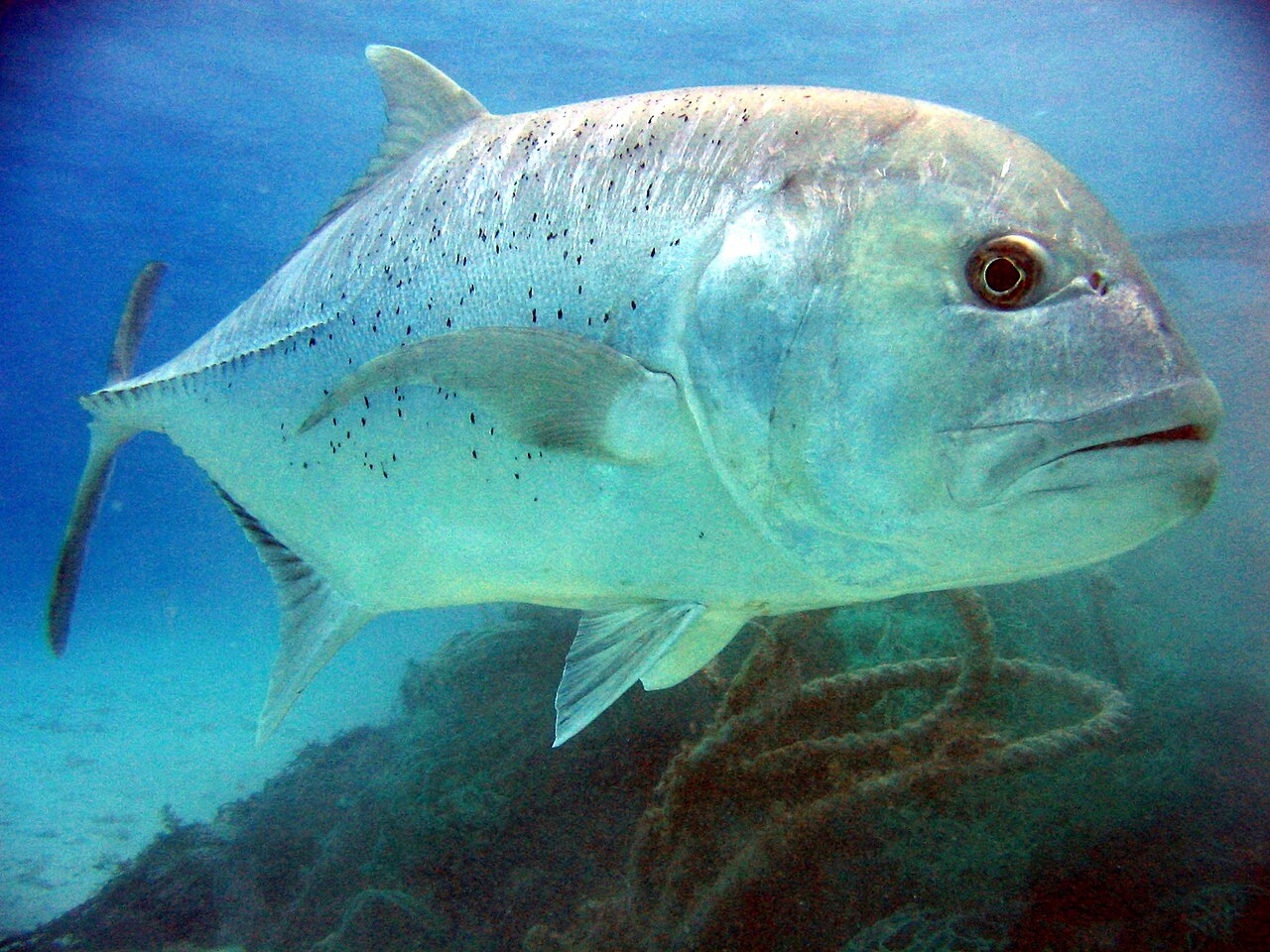
The giant trevally, also known as the lowly trevally, barrier trevally, giant kingfish, or ulua, is a species of large marine fish classified in the jack family, Carangidae. The giant trevally is distributed throughout the tropical waters of the Indo-Pacific region, with a range stretching from South Africa to Hawaii, including Japan in the north and Australia in the south.
Adapted from Wikipedia, licensed under CC BY-SA 4.0.
Easily confused with
Side by side, with what tells them apart.


Bluefin Trevally has electric-blue fins, blue-black spots scattered over the upper flanks once past about 16 cm, and a more pointed snout. Giant Trevally has grey to black fins and a steep, blunt forehead, and grows far larger -- up to 170 cm -- with big males turning dusky to jet black.
See the Bluefin Trevally →

Brassy Trevally is often taken for a Giant Trevally. It is lighter, brassy to yellow-green on the back and sprinkled with small black spots above the lateral line, with a pale, black-edged spot at the top of the gill cover and a thin white band along the rear edge of the tail. Giant Trevally is silvery grey to black, with at most a scattering of spots, and grows twice as large.
See the Brassy Trevally →

Big silver trevallies of the same reefs. Bigeye Trevally has a noticeably large eye, a white tip on its dark second dorsal fin and a small black spot at the top of the gill cover, and by day it gathers in large, slowly milling schools; the young carry five or six dark bars. Giant Trevally has a steep, blunt forehead and grey to black fins with no white tip, is usually met alone, and grows far larger, to 170 cm.
See the Bigeye Trevally →